Israel Travel Budget Calculator
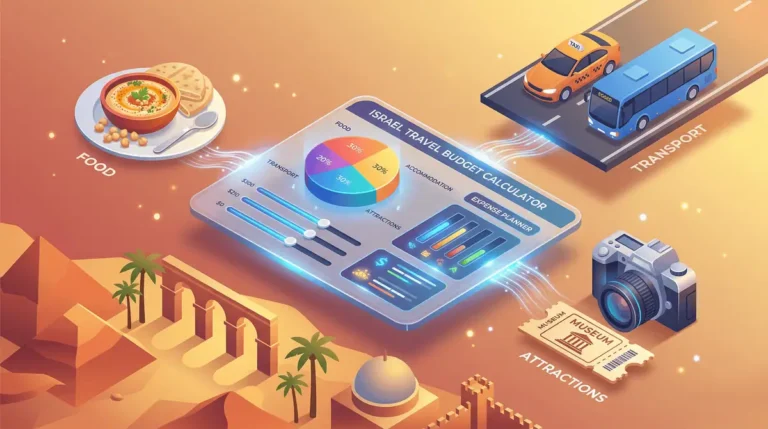
Wondering how much a trip to Israel costs? Use our free Israel Travel Budget Estimator to calculate your daily expenses for food, transport, and attractions.
Israel Budget Estimator
Calculate your daily spending (excluding flights & hotels)
Start from $0.06 per GB
Embed Israel travel budget estimator on your website
Help your readers plan their Israel budget! Copy the code below and paste it into your website or blog.
* To have affiliate link please contact us at: support@esimisrael.us
BUDGET
How Much Does a Trip to Israel Cost? Here is Free Budget Calculator
Planning a trip to the Holy Land is a dream come true for many Americans. From floating in the Dead Sea to walking the ancient streets of Jerusalem and experiencing the vibrant nightlife of Tel Aviv, Israel offers an unparalleled travel experience.
However, let’s address the elephant in the room right away: Israel is not a cheap destination. In fact, cities like Tel Aviv frequently rank alongside New York, London, and Singapore in global cost-of-living indexes. For first-time visitors from the US, the prices of food, transportation, and daily activities can come as a bit of a sticker shock if you aren’t prepared.
But don’t panic! You absolutely do not need to empty your life savings to have an incredible trip. With a bit of smart planning, understanding the local currency (the New Israeli Shekel – NIS), and knowing where to splurge and where to save, you can easily control your daily spending.
To take the guesswork out of your travel planning, we’ve built the Ultimate Israel Travel Budget Estimator. Use the free interactive calculator below to find out exactly how much “spending money” you will need per day based on your personal travel style.
(Note: This calculator focuses on your daily on-the-ground expenses. Flights and hotel accommodations are excluded, as most travelers pre-book and pay for those well in advance of their trip).
EXPENSES
Understanding Your Daily Expenses in Israel
Once you’ve used the calculator to get your baseline number, it helps to understand why things cost what they do. Here is a deep dive into the three main categories of your daily budget, with realistic price expectations for American travelers.
🍔 Food & Dining Costs (The Culinary Scene)
Israel has undergone a massive culinary revolution in the last decade. It is a paradise for foodies, offering incredible fresh produce, fusion cuisines, and world-class dining. How much you spend depends entirely on your habits.
The Budget Eater (Street Food & Markets): If you eat like a local on the go, you can eat incredibly well for very little. A massive, filling portion of falafel, sabich (an eggplant and egg pita), or shawarma from a street vendor will cost you between $8 to $15 USD (30 – 55 NIS). Pair that with fresh fruit and pastries from local markets for breakfast, and you can easily keep your daily food budget under $35-$40 a day.
The Mid-Range Traveler: If you prefer sitting down at nice cafes for breakfast (like a classic Israeli breakfast spread with eggs, cheeses, and salads) and dining at casual restaurants for dinner, expect to pay standard US major-city prices. A sit-down lunch or dinner with a soft drink or local beer will run you about $25 to $45 USD per person.
The Luxury Foodie: Tel Aviv and Jerusalem boast incredible chef-driven restaurants. If you are sitting down for fine dining, ordering craft cocktails (which average $15-$18 each), and enjoying a bottle of boutique Israeli wine, your dinner bill can easily exceed $80 to $150 USD per person.
🚕 Transportation Costs (Getting Around)
Getting from point A to point B in Israel is highly efficient, but the costs vary wildly depending on your chosen method.
Public Transport (Trains & Buses): This is the cheapest and most efficient way to travel. A standard inner-city bus ride costs less than $2.00 USD (5.50 NIS). The high-speed train connecting Ben Gurion Airport to Jerusalem or Tel Aviv is incredibly affordable, costing around $5 to $7 USD. If you use transit apps like Moovit, your daily spending is capped, meaning you will rarely spend more than $10-$15 a day on public transit.
Taxis & Ride-Hailing Apps: Uber is not widely used in Israel. Instead, locals use apps like Gett and Yango. Taxis are metered and generally expensive. A short 10-minute ride across Tel Aviv can easily cost $15 to $20 USD, and longer rides jump in price quickly, especially at night or on weekends.
Renting a Car: While renting a car gives you freedom (especially for visiting the Galilee or the Negev Desert), you must factor in the high cost of gasoline in Israel (often double the price per gallon compared to the US) and exorbitant daily parking fees in major cities.
🎟️ Attractions & Activities (Sightseeing)
The good news is that Israel offers a wealth of profound experiences that cost absolutely nothing. The bad news is that private tours and premium attractions can eat into your budget.
Free & Low Cost: Walking the Old City of Jerusalem, exploring the Bahá’í Gardens in Haifa, relaxing on the pristine beaches of Tel Aviv, and wandering through vibrant markets (Shuks) are completely free.
Standard Admissions: Entry to most national parks (like Masada or Caesarea), major museums (like the Israel Museum or Yad Vashem), and paid historical sites usually ranges from $8 to $15 USD per adult.
Premium Experiences: If you want a private guided walking tour of the Old City, a VIP day-pass at a Dead Sea resort, or a specialized culinary tasting tour in Carmel Market, expect to pay anywhere from $70 to $150+ USD per person.
SAVE
10 Smart Ways to Save Money in Israel
You don’t need to skip the fun to stay within your budget. Here are 10 highly effective, actionable tips to keep your wallet happy while enjoying the trip of a lifetime.
1. Avoid Hidden Roaming Fees (Get an Israeli eSIM)
This is the #1 most common mistake American tourists make. If you use your US carrier’s international day pass (like AT&T International Day Pass or Verizon TravelPass), you are charged $10 to $12 per day, per device. For a couple traveling for two weeks, that is **$280 wasted** just to use Google Maps and WhatsApp! Instead, ensure your phone is unlocked and get an Israeli eSIM before you fly. You can get a robust local data plan for your entire trip for around $30-$60. You stay connected, your transit apps work flawlessly, and you save hundreds of dollars that you can spend on a phenomenal dinner instead.
2. Take Advantage of the “Iskit” (Business Lunch)
If you want to eat at top-tier restaurants without paying top-tier prices, eat your biggest meal in the middle of the day. Most Israeli restaurants offer an Iskit (עסקית), which translates to “Business Lunch.” Typically available Sunday through Thursday between 12:00 PM and 4:00 PM, an Iskit allows you to get a starter, a main course, and sometimes a drink for a fixed, heavily discounted price.
3. Drink the Tap Water
When you sit down at a restaurant in the US, ice water is brought to the table automatically. In Israel, waiters will often ask if you want bottled mineral water or sparkling water (which they will charge you $4-$6 for). Always kindly ask for “Mayim Berez” (tap water) or a pitcher of regular water. Tap water in Israel is completely safe to drink, heavily monitored, and free! Bring a reusable water bottle and fill it up throughout the day.
4. Shop at Local “Shuks” (Open-Air Markets)
Skip the standard grocery stores or convenience shops when you want a snack. Head to places like Carmel Market in Tel Aviv or Mahane Yehuda in Jerusalem. Not only is the experience culturally immersive, but you can also buy fresh fruits, nuts, massive dates, and authentic pastries for a fraction of the cost of a cafe. Grab a fresh pita, some local cheese, and hummus, and have a world-class picnic on the beach for under $10.
5. Master the Public Transit System
As mentioned in our Public Transport Guide, you should avoid taxis whenever possible. Israel has an exceptional, modern network of buses, light rails, and heavy rail. Download the Moovit app, ensure your eSIM is active, and pay pennies on the dollar to get exactly where you need to go safely and quickly.
6. Buy the “Israel Pass” for National Parks
If you are an avid history buff or nature lover planning to visit multiple national parks (like Masada, Ein Gedi, Caesarea, Megiddo, or Beit She’an), do not buy individual tickets at the gate. The Israel Nature and Parks Authority sells a combined Israel Pass. You can buy a pass for 3 or 6 sites, which will save you an average of 25% on admission fees and allow you to skip the ticket lines.
7. Use Sheruts (Shared Taxis) Instead of Private Cabs
If public transport isn’t available (especially during Shabbat when trains and public buses stop running), do not immediately call a private taxi. Look for a Sherut (Monit Sherut). These are yellow 10-seater minivans that drive along major bus routes. You simply flag them down, hop in, pass your cash up to the driver, and pay a flat fee that is only slightly higher than a bus ticket, but massively cheaper than a private cab.
8. Look for Free Walking Tours
Jerusalem, Tel Aviv, and Haifa are cities best explored on foot. Several organizations and hostels offer “Free Walking Tours” led by incredibly knowledgeable local guides. These tours operate on a tip-based system. You get a fantastic 2-hour orientation of the city’s history and architecture, and at the end, you simply tip the guide what you feel the tour was worth (usually $10-$15 per person is a respectful amount).
9. Don’t Over-Tip
Unlike the United States, where tipping 20% to 25% is becoming the norm, the tipping culture in Israel is much more restrained. Waitstaff in Israel make a higher base wage. The standard tip at a sit-down restaurant is 10% to 12% for good service, and 15% only for exceptional service. Furthermore, you do not need to tip taxi drivers, bartenders pouring a simple beer, or counter-service workers (like at coffee shops or falafel stands).
10. Claim Your VAT Refund at the Airport
Israel charges a 17% Value Added Tax (VAT) on almost all goods and services. However, as a foreign tourist, you are exempt from paying VAT on hotel stays and car rentals. Even better, if you buy goods (jewelry, souvenirs, clothing, dead sea cosmetics) at participating stores, you can get that 17% tax refunded to you when you leave the country! Make sure the store gives you a specific “VAT Refund Invoice,” keep the items in your carry-on, and visit the VAT refund counter at Ben Gurion Airport before your flight home.
FAQ
Frequently Asked Questions
Do I need to leave a tip in Israel, and how much?
Yes, tipping is expected at sit-down restaurants, but the rates are lower than in the US. A standard tip is 10% to 12%. For outstanding service, 15% is appreciated. You do not need to tip taxi drivers, fast-food workers, or when ordering takeout. Be aware that many Israeli restaurants cannot add a tip directly to your credit card, so it is highly recommended to carry some small Shekel bills to leave on the table.
Can I use US dollars or Euros in Israel?
While some major hotels and tourist-heavy shops in the Old City of Jerusalem might accept US dollars, it is not common practice, and you will receive a terrible exchange rate. The official currency is the New Israeli Shekel (NIS). You should use Shekels for cash transactions or rely on a travel credit card with zero foreign transaction fees for your daily purchases.
Are credit cards widely accepted, or do I need cash?
Israel is a highly digital and cashless society. Visa and Mastercard are accepted almost everywhere, from modern restaurants to small market stalls. Apple Pay and Google Pay are also extremely prevalent. You only need a small amount of cash (Shekels) for specific situations: tipping at restaurants, buying small items in the Arab shuks (markets), or taking a shared Sherut taxi.
Is Tel Aviv more expensive than Jerusalem?
Generally, yes. Tel Aviv is the commercial and tech hub of the country, known for its premium nightlife, beachfront real estate, and chef restaurants. Your budget for food, drinks, and entertainment will stretch further in Jerusalem than it will in central Tel Aviv.
How much does a typical meal cost in Israel?
It varies wildly by the type of establishment. A casual street food meal (falafel/shawarma with a drink) costs $10-$15. A sit-down lunch at a cafe costs $20-$30. A nice dinner at a mid-range restaurant will cost $40-$60 per person. Fine dining can easily exceed $100 per person without alcohol.
Do I need to bargain or haggle over prices?
In modern retail stores, malls, restaurants, and supermarkets, prices are fixed and haggling is not acceptable. However, in the traditional open-air markets (like the Shuk in the Old City of Jerusalem or Carmel Market in Tel Aviv), bargaining is a cultural norm for souvenirs, jewelry, ceramics, and clothing. (Do not haggle over fresh food or produce, however).
Is alcohol expensive in Israel?
Yes, alcohol is heavily taxed in Israel and is generally more expensive than in the United States. A standard pint of local beer (like Goldstar or Maccabi) at a bar will cost around $8 to $10. Craft cocktails in Tel Aviv average $15 to $18. If you want to save money, look for “Happy Hour” deals which are very popular in the early evenings (usually offering 1+1 on drinks).
Are things cheaper during Shabbat (Friday evening to Saturday evening)?
No, in fact, traveling during Shabbat can be more expensive. Because public transportation (buses and trains) completely shuts down, you will be forced to rely on private taxis, which are allowed to charge a legal “weekend surcharge” (usually 25% higher than the weekday rate). Additionally, the few restaurants that remain open on Shabbat in secular areas are often completely booked and do not offer budget-friendly “business lunch” specials.
Israel Travel Budget | How Much Money Do You Need?
Wondering how much a trip to Israel costs? Use our free Israel Travel Budget Estimator to calculate your daily expenses for food, transport, and attractions.
Price Currency: USD
Operating System: Web Browser
Application Category: TravelApplication
5